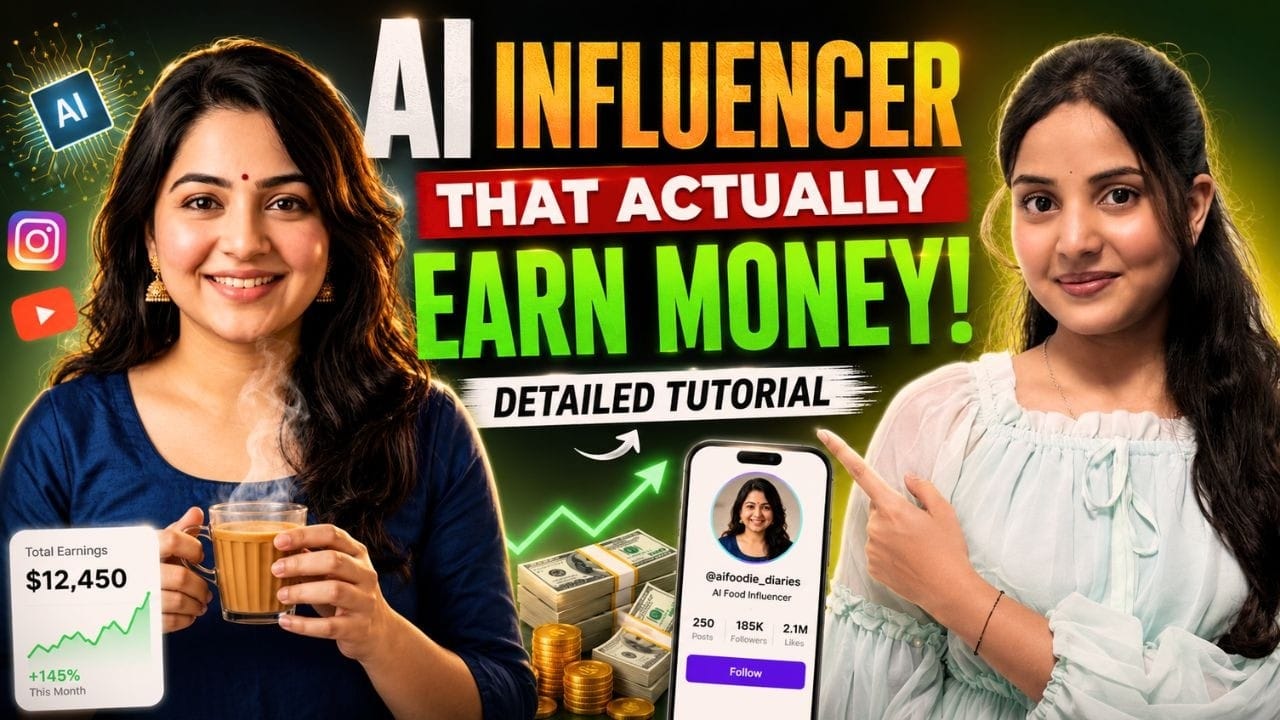
AI influencers are everywhere today. Creating a realistic virtual person has become surprisingly easy, but creating an AI influencer that people actually follow, trust, and engage with is a completely different challenge.
A few attractive images or random dancing videos aren’t enough to build a successful influencer page. If you want your AI influencer to eventually attract an audience and potentially work with brands, you need to treat it like a real digital personality.
That means building a clear niche, recognizable identity, personality, backstory, consistent face, consistent voice, and long-term content strategy.
Here is how you can build one from scratch.
Step 1: Choose a Specific Niche
Before generating your character, decide what type of content the influencer will create.
Possible niches include fashion, food, travel, fitness, beauty, technology, education, lifestyle, and entertainment.
For this example, we’ll create an Indian food influencer.
But “Indian food” is still quite broad. We can narrow it down further to North Indian home cooking.
This gives the influencer a much clearer content direction.
Instead of posting random food videos, the account can focus on quick recipes, traditional cooking tips, common cooking mistakes, family recipes, and easy North Indian meals.
Step 2: Decide Your Target Platforms
Next, determine where you want to publish your content.
You could focus on Instagram alone or simultaneously create content for platforms such as:
- YouTube
- TikTok
Creating short-form vertical videos makes it easier to repurpose the same concept across multiple platforms.
Regardless of the platforms you choose, your influencer’s identity should remain consistent.
Step 3: Create a Complete Persona
Now comes one of the most important steps: building the influencer’s personality.
Don’t start by asking an AI tool to simply create “a beautiful AI girl.”
Instead, define who she actually is.
Determine her:
- Name
- Age range
- Personality
- Niche
- Background story
- Communication style
- Target audience
- Content style
For example, our character could be a young, energetic and trendy North Indian cooking creator who shares easy recipes inspired by her family’s kitchen.
This simple backstory immediately makes the character more memorable.
Step 4: Match the Character With the Content
Your character should visually and emotionally match the niche.
A young cooking influencer targeting younger audiences might have an energetic personality, modern outfits, expressive body language, and a conversational speaking style.
A creator focused on traditional recipes might have a softer and more family-oriented personality.
There is no single perfect personality.
The important thing is that everything feels connected.
Step 5: Generate Your AI Influencer
Once the persona is ready, create a detailed image-generation prompt.
You can use an AI assistant to help convert your persona into a professional image prompt.
Generate the first reference image and carefully examine it.
Don’t settle for the first result if it doesn’t match your vision.
Adjust details such as:
- Age
- Hairstyle
- Facial features
- Clothing
- Expression
- Environment
- Overall personality
Continue refining until you find a character that truly fits your content idea.
Step 6: Create Multiple Reference Images
One reference image isn’t enough if you want strong character consistency.
Generate approximately 10–15 different shots of the same character.
Include different:
- Camera angles
- Facial expressions
- Hairstyles
- Outfits
- Locations
- Close-ups
- Medium shots
- Lifestyle situations
The character’s clothes and environment can change.
What shouldn’t change dramatically is the character’s core facial identity.
Having multiple references makes it easier to create future images and videos without accidentally generating a completely different person.
Step 7: Save the Character
If your generation platform allows reusable characters, save your selected reference as a character.
In a Google Flow-based workflow, for example, the character can be added to a project and referenced while generating future scenes.
This reduces the need to recreate the influencer every time.
You now have a reusable digital creator.
Step 8: Give Your Influencer a Consistent Voice
Visual consistency is only half the job.
Your AI influencer should also have a recognizable voice.
If the character sounds completely different in every video, viewers may find it difficult to connect with the personality.
Try to maintain consistency in:
- Voice
- Accent
- Language
- Speaking speed
- Energy
- Vocabulary
- Personality
If your influencer speaks Hinglish, for example, keep that communication style consistent across future videos.
Step 9: Create Talking AI Videos
Now you can turn the static influencer into a video creator.
Instead of giving your AI video generator a basic description, create complete scenes.
Your prompts can include:
Character + Location + Camera + Action + Expression + Dialogue + Voice + Lighting
For a cooking influencer, you could create a medium shot inside a realistic kitchen where the character looks at the camera and explains a quick cooking trick while naturally using hand gestures.
The result should feel like genuine creator content rather than a character simply standing in front of the camera.
Step 10: Generate Short Clips
Instead of trying to create an entire long video at once, break your script into smaller clips.
For example:
Clip 1: Strong hook
Clip 2: Explain the problem
Clip 3: Give the solution
Clip 4: Conclusion
Four clips of around eight seconds each can create a video of approximately 30–32 seconds.
This also gives you more control.
If one clip isn’t good, you can regenerate that section without recreating the entire video.
Step 11: Create the Social Media Page
Once you have the influencer and initial content ready, it’s time to create the actual account.
Your username should ideally connect the character’s name with the niche.
Then optimize the display name.
For example:
Zara | North Indian Home Cooking
This is much more informative than simply using “Zara.”
Anyone visiting the profile can immediately understand what the account is about.
Step 12: Write a Strong Bio
Your bio should clearly communicate what followers can expect.
Avoid generic phrases that don’t provide any real information.
Instead, use something specific such as:
Quick North Indian recipes 🌶️
Easy home cooking & practical tips
Fresh recipes every week 🍛
Your bio should reinforce the same identity established through your content.
Step 13: Choose the Right Profile Picture
Choose a clean portrait from your reference set.
The face should be clearly visible because social media profile pictures appear very small.
Avoid complicated backgrounds or extremely wide shots.
Your AI influencer should be instantly recognizable.
Step 14: Post Consistently
Don’t expect thousands of views immediately.
Your first few videos may receive very little engagement.
That’s completely normal.
Continue posting while improving:
- Hooks
- Video quality
- Storytelling
- Editing
- Topics
- Captions
- Thumbnails
- Posting times
Consistency allows you to learn what your audience actually wants.
Step 15: Test Different Posting Times
Experiment with different publishing times and monitor when your audience is most active.
Once you identify a strong time window, try to maintain a predictable schedule.
For example:
New Recipe Every Friday at 4 PM
If you make this promise, publish consistently around that time.
Predictability helps turn occasional viewers into regular followers.
Step 16: Stay Within Your Niche
Trends are useful, but don’t allow them to completely change your page.
If your account is about North Indian cooking, participate in food-related trends rather than suddenly posting unrelated fashion, gaming, or motivational videos.
You can change your presentation.
You can experiment with formats.
You can improve your style.
But your core identity should remain recognizable.
Final Formula
A strong AI influencer can be built around this formula:
Specific Niche + Strong Persona + Backstory + Consistent Face + Consistent Voice + Valuable Content + Consistent Posting
AI tools can help you create the face, images, voice, and videos.
But those tools alone don’t create influence.
What creates influence is identity and consistency.
Treat your AI influencer like a real content brand instead of a collection of AI-generated videos. Give the audience a reason to recognize the character, follow the story, return for future content, and eventually trust the personality behind the page.
That’s when an AI character can start becoming an actual AI influencer.