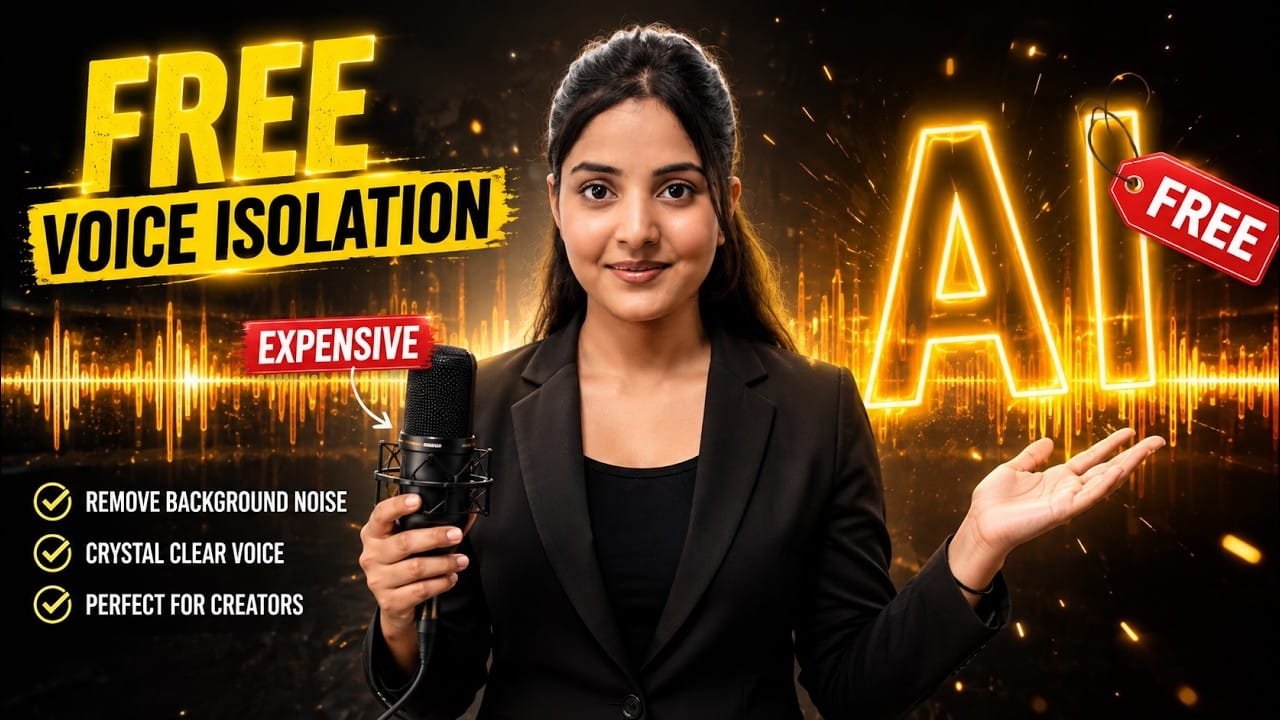
Good audio quality is just as important as good video quality. Whether you create YouTube videos, Instagram Reels, podcasts, tutorials, or AI-generated content, background noise and poor voice quality can make even professionally edited content feel low-quality.
A premium microphone can help, but not every creator wants to spend a large amount of money on audio equipment. This is where MiniMax Audio can become a useful AI-powered alternative.
MiniMax Audio combines several audio features in one platform, including Text-to-Speech, Voice Cloning, Voice Design, Voice Isolation, and a library of AI voices. The tutorial also shows that its free version provides 10,000 credits per month.
Generate AI Voiceovers with Text-to-Speech
MiniMax Audio’s Text-to-Speech feature allows you to enter a script and transform it into an AI-generated voiceover.
However, it goes beyond simply converting text into speech.
You can select particular words and add emotions such as happiness, surprise, or fear. This gives creators more control over how individual parts of a sentence are delivered.
Custom pauses can also be inserted into the script. You can decide where the speaker should pause and customize the duration of that pause.
These controls can make AI narration feel more expressive and suitable for storytelling, advertisements, short-form videos, and educational content.
Add Human-Like Sounds
Another interesting option is the ability to add sound tags.
The tutorial demonstrates human-like elements such as breathing, chuckling, and coughing. Adding these small details can make an AI-generated voice feel less robotic and more conversational.
Users can also adjust the speed, pitch, and volume of the selected AI voice before generating the final audio.
Create a Custom AI Voice
Instead of choosing an existing voice, MiniMax Audio also allows users to describe the kind of voice they want.
For example, you could request a soft female narrator, an energetic promotional voice, or a cinematic old-school narrator.
You simply describe the characteristics of the desired voice and provide some text for the generated voice to speak. The tutorial also suggests using ChatGPT to help write detailed voice descriptions.
This can be particularly useful for AI influencers, fictional characters, faceless YouTube channels, and storytelling projects.
Clone Your Own Voice
Voice cloning is another major feature.
You can upload an audio sample or record your voice directly through your microphone. The tutorial specifies a recording duration of approximately 10–60 seconds for the demonstrated cloning workflow.
Once your voice has been processed, you can enter a script and generate new speech using the cloned voice.
The platform also provides options for removing background noise from the source recording and optimizing the accent before creating the clone.
Voice cloning should, of course, be limited to your own voice or voices you have permission to use.
Remove Background Noise with Voice Isolation
For everyday creators, Voice Isolation may be one of MiniMax Audio’s most useful features.
Background noise can appear almost anywhere—traffic outside your room, construction work, rain, fans, air conditioners, or people talking nearby.
With Voice Isolation, you can upload a noisy audio recording and let AI separate the main speech from unwanted background sounds.
In the tutorial demonstration, a noisy recording is processed into a much cleaner version while the speaker reports that her voice remains intact throughout the tested audio.
This could potentially save creators from having to re-record an entire video simply because the original audio contains background noise.
What If Your Audio Is Inside a Video?
If you have a video file instead of an audio recording, you can first extract its audio.
The tutorial demonstrates exporting audio separately from an editing tool. Alternatively, an MP4-to-MP3 converter can be used to turn the video’s audio track into a standalone file.
The workflow becomes:
Video → Extract Audio → Remove Noise → Download Clean Audio → Add Audio Back to Video
This is a simple solution for creators who already have completed footage but need cleaner speech.
Is MiniMax Audio Worth Trying?
MiniMax Audio combines several AI audio capabilities that creators would otherwise potentially need multiple tools to perform.
You can:
- Generate AI voiceovers
- Add emotions and pauses
- Add human-like sound effects
- Control speed, pitch, and volume
- Design original AI voices
- Clone authorized voices
- Remove background noise
- Optimize recordings
- Isolate speech from noisy audio
For YouTubers, social media creators, AI influencers, educators, marketers, and faceless content creators, having these features together can simplify the audio production process.
Conclusion
Professional-looking content deserves professional-sounding audio.
MiniMax Audio demonstrates how AI can reduce some of the traditional barriers to producing cleaner and more expressive voice content. Instead of relying exclusively on expensive microphones and complex audio-editing workflows, creators can use AI for everything from voice generation to background-noise removal.
For creators exploring AI-powered production in 2026, MiniMax Audio is an interesting platform to test—particularly for its Voice Isolation, Voice Cloning, Voice Design, and advanced Text-to-Speech features.